

Everyone knows that driving an RV means you’re going to need to be more aware of your blind spots. RV’s are notorious for taking up a lot of space. Thus, it can sometimes be easy to overlook other cars in your rearview mirror. To help increase your safety, you should consider investing in RV backup cameras.
These cameras will give you extra vision in the spots you need most and can keep you from causing an accident. They are also great in most weather conditions and can help you monitor other objects that may prevent you from driving smoothly during the day or night.
Comparison Chart
| Our Pick | Image | Product | Key Feature | |
|---|---|---|---|---|
| Best Overall |  | Rear View Safety 4-Camera System with Quad View Display (RVS-062710) | Best Overall – 4 cameras on one quad-view display | Check Price on Amazon |
| Best Wired | 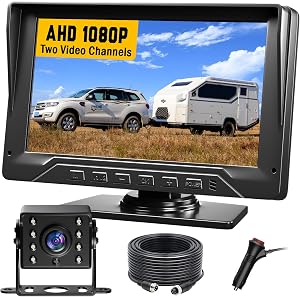 | FEISIKE 7-inch Wired RV Backup Camera System | Best Wired – 2 channels, 1080P, adjustable guide lines | Check Price on Amazon |
| Best Wireless |  | 4Ucam Digital Wireless 2-Camera System + 7-inch Monitor | Best Wireless – two digital wireless cameras, quad split screen | Check Price on Amazon |
| Best Budget |  | AMTIFO Wireless RV Backup Camera System (2 HD 1080P cameras) | Best for Furrion pre-wired RVs – 7-inch split-screen monitor | Check Price on Amazon |
| Best Hitch Camera |  | AUTO-VOX 5-inch Magnetic Wireless Hitch Camera | Best Hitch – magnetic mount, no wiring | Check Price on Amazon |
As an Amazon Associate we earn from qualifying purchases.
Best RV Backup Camera Reviews
1. Best Overall – Rear View Safety Backup Camera System
This camera kit is designed to come with all the components you’d need to set up a four-camera system with quad view displays. The setup may be complicated, but all components that are needed to install the rear view camera are already in the box. This means you’ll save time having to hunt down each component.
Rear View Safety 4-Camera System with Quad View Display (RVS-062710)
Best Overall – 4 cameras on one quad-view display
Check Price on AmazonSummary
This unit comes with a 7-inch TFT LCD color monitor which has both single, double, triple, and quad camera options. Two heavy-duty cameras are also included, meaning you don’t have to worry about replacements. All of the cameras are waterproof and have a 120-degree view angle. All cameras have night vision and come with infrared lighting. The whole system is included in the kit, and it is easy to install.
PROS
- 7” TFT LCD monitor
- Infrared lights
- Waterproof
- 130 degree angle
- Night vision
CONS
- No DVR Output
2. Best Wired – FEISIKE 7-inch Wired Backup Camera System
This wired system comes with a 7-inch 1080P HD monitor and a rear camera. The wired connection means there is no signal delay and no wireless interference. The monitor has 2 channels, so you can add a second camera and switch between views.
FEISIKE 7-inch Wired RV Backup Camera System
Best Wired – 2 channels, 1080P, adjustable guide lines
Check Price on AmazonSummary
Setup is plug and play. The monitor runs off a 12V source like the cigarette lighter, and a 66-foot cable runs back to the camera. The camera has a 150-degree view angle, LED night vision that turns on by itself in low light, and an IP69 waterproof rating. You can adjust the parking guidelines, and a sun shade on the monitor cuts down glare.
PROS
- 7” 1080P HD monitor
- 150 degree angle
- No signal delay
- Night vision
- IP69 waterproof
CONS
- Has to be wired back to the monitor
3. Best Wireless – 4UCam Digital Wireless Camera
The 4UCam has two digital wireless cameras which each have a 7-inch monitor quad viewing system. This is perfect for larger vehicles such as buses, RVs, trailers, motor homes, and any other set of wheels that needs wider coverage of blind spots. The two digital wireless cameras have no interference and static, a common issue you will find with other wireless models. Unlike other models before this, it gives crystal-clear images even though it has a wireless connection, thus providing you with the best of both worlds.
4Ucam Digital Wireless 2-Camera System + 7-inch Monitor
Best Wireless – two digital wireless cameras, quad split screen
Check Price on AmazonSummary
The quad view monitor gives you options of either multiple or single views. The SD card allows you to record footage. The whole camera is covered with a metal case which is shock resistant and waterproof. The 11 high-powered IR LEDs offer you up to 15 feet of night vision and high-resolution CCD. It has a completely wireless system, which means you won’t have to waste your time installing extra wires or cables in your RV. It comes complete with everything you’d need to install it.
PROS
- Wireless
- Quad view monitor
- Split display
- Night vision
- Easy installation
CONS
- Fogs
4. Best Budget – AMTIFO Wireless RV Backup Camera System
The AMTIFO kit comes with 2 HD 1080P wireless cameras and a 7-inch split-screen monitor. It also comes with a Furrion adapter bracket and pigtail wire, so it works with RVs that are pre-wired for Furrion cameras.
AMTIFO Wireless RV Backup Camera System (2 HD 1080P cameras)
Best for Furrion pre-wired RVs – 7-inch split-screen monitor
Check Price on AmazonSummary
The monitor can record, and it uses loop recording, so it writes over the oldest files when the memory card is full. It has 4 channels, so you can add more cameras later. You can change the width of the parking lines and move them left, right, up or down to match what you see. It also has night vision. AMTIFO gives a 2-year warranty and a 30-day money-back guarantee.
PROS
- Wireless
- Furrion pre-wire compatible
- Split-screen monitor
- Loop recording
- Night vision
CONS
- Needs a memory card to record
5. Best Hitch – AUTO-VOX Magnetic Wireless Camera
Do you enjoy camping or traveling to remote locations but hate the annoying process of hitching the trailer to your vehicle? Sometimes with an RV or a motorhome, it’s almost impossible to line up your vehicle correctly.
The AUTO-VOX is a wireless camera with a magnetic mount, so there’s no wiring and it installs in about a minute. You can put it on your RV or trailer when you hitch up and take it off when you’re done.
AUTO-VOX 5-inch Magnetic Wireless Hitch Camera
Best Hitch – magnetic mount, no wiring
Check Price on AmazonSummary
It comes with a 5-inch wireless monitor. Because the camera mounts with a magnet, you won’t have to drill into or damage your vehicle to use it.
PROS
- Wireless
- Magnetic mount
- No wiring
- 5-inch monitor
BUYER’S GUIDE
Things To Consider Before Buying A Backup Camera
There are a few different factors that you should consider when purchasing a rearview camera. They are listed below.
Sensors
Most of the backup cameras will either use CMOS or CCD sensors. These sensors work by converting light signals in two different ways. A CMOS sensor will use less power and is better in low-lit conditions, but a CCD sensor is better when adapting to lighting scenarios. Depending on which environments you are driving in, you may need a different type of sensor. There is no sensor that is better than the other; you have to assess what type of driving conditions you’re going to be facing.
Parking Lines
Many backup cameras can provide you with onscreen guidelines which can help you position the RV when you’re trying to park in a crowded area. This can be very helpful for those people who tend to be horrible at parking. Instead of risking scraping your or someone else’s car, you can use the parking lines to help assess how to park. They will help guide you through the distances you are away from other cars. If you don’t want the parking lines to show, you can easily turn the setting off.
Mirror Images
This is a feature of where the monitor will reverse and mimic what’s in the rearview mirror. This is especially important when you’re trying to monitor pedestrians or other obstacles in crowded locations.
Viewing Angle
A rearview camera can help give you both horizontal viewing angles and an expansive 190-degree angle. The wider the angle, the more you will be able to see.
Low Lights
This is the amount of light which you need for a decent picture. At night you should have around 0.1 lux, and in the daytime, you should have around 10,000 lux. Cameras can give a clear picture with 0.1 lux. Make sure you understand what type of weather conditions you’re going to be driving through.
Mounting
When purchasing a rearview camera, you should always make sure that your preferred method of mounting is one of the feature. There are some older models which can’t be mounted on your RV. Make sure that you select a camera with your preferred mounting styles.
Wired vs. Wireless
When trying to decide which type of rearview camera to buy, you will need to know if you want to install either a wireless model or a wired model. These each has their strengths and weaknesses, so be prepared with the knowledge of what each type offers.
Wired Rearview Camera
Wired rearview cameras are often high quality and are very reliable regarding capturing video and pictures. The only issue is that they aren’t as convenient as wireless models. To install these models, you will have to wire your vehicle and learn how to accommodate the camera system you purchase.
You can hire a professional who can install it for a price, but do you want to be spending extra money just to install an already expensive rearview camera? For longer RVs, the installation process requires even more wiring and work, thus making it difficult to install for a reasonable price. So, in review, you should choose wired rear view cameras only if you want to have the best possible quality.
Wireless Rearview Cameras
Wireless is going to be a lot easier to install and don’t require you to shove out extra money for installation. This can save you money regarding investing in a better wireless camera instead of having to save up for crazy installation prices. The wireless systems do have a chance of having interference from other frequencies such as radios, so you will need to be aware of that. Wireless cameras also allow you to have a simple dashboard monitor and you can even stream to your mobile devices.
Backup Camera Field Of View
When you’re purchasing a rear view camera, you’re going to want to know the best angle to choose. This is because it highly influences the crisp and clear image you get when streaming to the monitor or TV.
Backup Camera Field Of View
A rearview camera can help supplement as a rearview mirror. It’s great for larger vehicles and RV’s because it can function as a way to keep sight of your blind spots. This can help increase your safety regarding both parking and driving. Every car has blind spots, and drivers usually can’t see where those blind spots are no matter how hard they turn their mirrors. Many accidents can be prevented through the use of rearview cameras, as they give you access to preventing accidents before they happen.
The standard rearview camera can be mounted onto the back of the RV and will feed camera footage to a screen that is mounted near your steering wheel. It’s essentially a TV which works similarly to a security camera. One feature that is unique to rearview camera systems is that it can provide a mirror image, thus preventing accidents before they happen.
What Determines View Angles
Camera angles are a product of two different factors: the sensors and the lens. For larger sensors, this can provide you with a wider angle. A 1/4-inch sensor can support either 60-90 degree angles, and a 1/3-inch sensor can support 120 degrees. Many cameras will come with large fields of views, but you need to make sure that the sensor is adequate. An increased field of view isn’t good if you can’t improve the effectiveness of the cameras.
Comparing View Angles
When deciding which rearview camera to mount on your RV, there are many important features to keep in mind. One of the most important features is going to be the view angle. Each view angle has its own pros and cons. As a rule of thumb, the wider the angle, the more disadvantages you’re going to have. You don’t need a very wide view angle to help you check your blind spots, so overdoing it isn’t going to give you much benefit.
60 Degree
This is the narrowest view angle that you’re going to see available on the market. It’s usually not the best of choices, and that’s because it only provides 30 degrees of view past the center of the camera. The problem is that in most cases, it does not provide you with enough coverage of the vehicle’s blind spots. This defeats the purpose of having a rearview camera in the first place. This means it’s essentially a replacement for main rearview mirrors but doesn’t offer many benefits. These cameras can benefit you while driving, but you would benefit even more from a wider viewing angle.
90 Degree
The next upgrade to viewing angles that you’re going to find on the market is 90-degree angles. This should be the range you should be aiming for if you’re trying to purchase a rearview camera. This means that you will be getting around 45 degrees coverage from the cameras centerline.
This gives you enough viewing angles to see oncoming traffic and pedestrians. While these cameras can cover a vehicles main blind spots, they only provide a moderate amount of coverage. This means you’ll still have to check the camera and mirrors to ensure that there isn’t anything in your blind spot. These cameras should be what you aim for if you’re starting out, but they aren’t the best choice for viewing angles.
120 Degree
The next viewing angle is a 120-degree view angle. This is going to be the best choice when you’re choosing a rearview camera for your RV. It will give you a wide field of clarity and give you even more viewing than the other models. These cameras give you 60 degrees of coverage from each centerline, and this allows you to not only see the RV’s blind spots but also make sure there are no other objects that are coming into the camera’s field of view. The only downside to a 120-degree camera is that it’s going to be more expensive and harder to display the image as clear.
210 Degree
Lastly, the largest view angle that you’re going to see on the market for rearview cameras are the 210-degree models. They are not worth the price and often defeat the purpose of a rearview camera. The issue with these cameras is that they will give you more view, but reduce the accuracy and clear image that you would see displayed on the TV monitor. Thus, it makes it hard to spot any objects that may be hazardous when driving. This essentially defeats the purpose of a rearview camera and isn’t worth the extra money that you’re going to have to shell out.
RV Backup Camera Accessories To Consider?
When you’re choosing your purchase of a rear-view camera, there area few accessories you can consider to help make your RV rearview camera better. They are listed below.
Backup Camera Cable Adapters
If you’ve purchased a wired camera, you’re going to want to invest in backup wires. You never know when you’re going to run into troubles out on the road; therefore, investing in extra wires can be a lifesaver.
External Quad Screen Processors
If you’re trying to split your screen or have multiple displays at once, then an external quad screen can help you. This can come in handy when you have more than one camera installed or mounted on your RV.
Microphone Relocation
Not all rearview cameras come with a microphone, and honestly, they are not needed. They can help you determine the direction of the incoming hazard, but they aren’t going to help you in the long run.
Safety Lighting
You can attach safety lighting if you want to attach one to your RV. This can help you in a crisis when your RV malfunctions or the engine isn’t working right. This can help notify other drivers of your RV’s malfunctions and prepare them for any incoming trouble.
Conclusion
As you can see, an RV rear view camera can come in handy when you’re driving your RV. It can help you locate your blind spots and help increase your safety while you’re traveling out on the open road. Weather conditions, wildlife, and construction can easily make its way into your blind spot and cause you to get into an accident.
It’s been proven that a rearview camera can prevent accidents while driving. Anyone can miss something in their blind spot, so don’t think that you don’t need extra vision. If you’re going to choose a rearview camera, you should go with the 120-degree angle. This will give you enough coverage where you can see people in other lanes and other obstacles that are outside of the road but also gives you a clear enough vision of your surrounding area.
Be sure to check with your insurance company about discounts on your premiums for having rearview a camera system on your vehicle. Most vehicle insurance companies will give a sizable discount to vehicles with rearview cameras because they have been proven to reduce accidents and thus, reduce the amount of money insurance companies would have to pay out to honor any claims.