
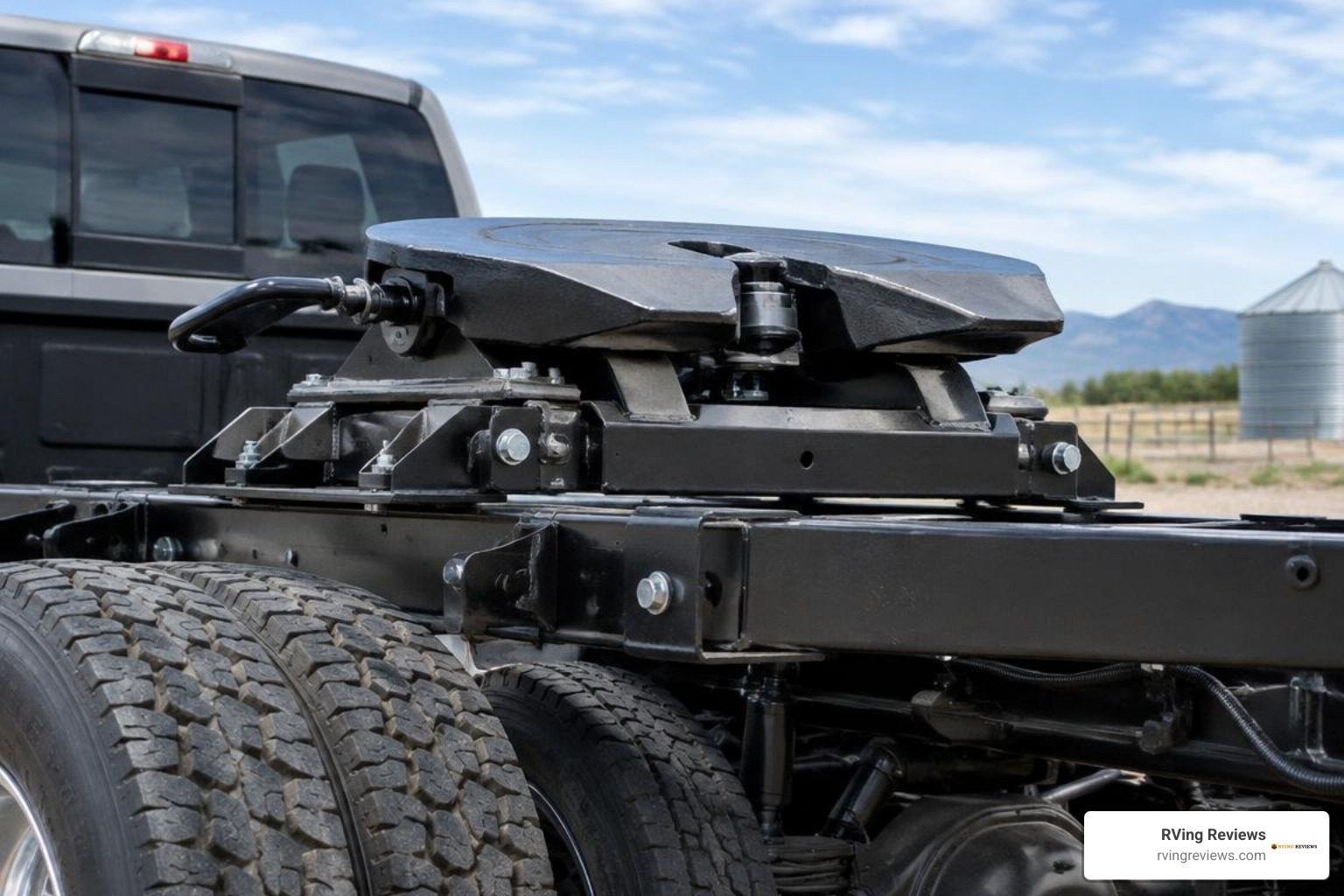
Understanding How a 5th Wheel Adapter for Transfer Trailer Setups Functions
Operating heavy haulers, commercial transfer trailers, and large fifth-wheel campers often leaves drivers facing a common hurdle: mismatched connection systems between the pickup truck and the trailer. A fifth-wheel setup relies on a kingpin securing into a bed-mounted hitch plate, whereas a gooseneck setup locks down onto a 2-5/16-inch hitch ball positioned directly over the truck’s rear axle.
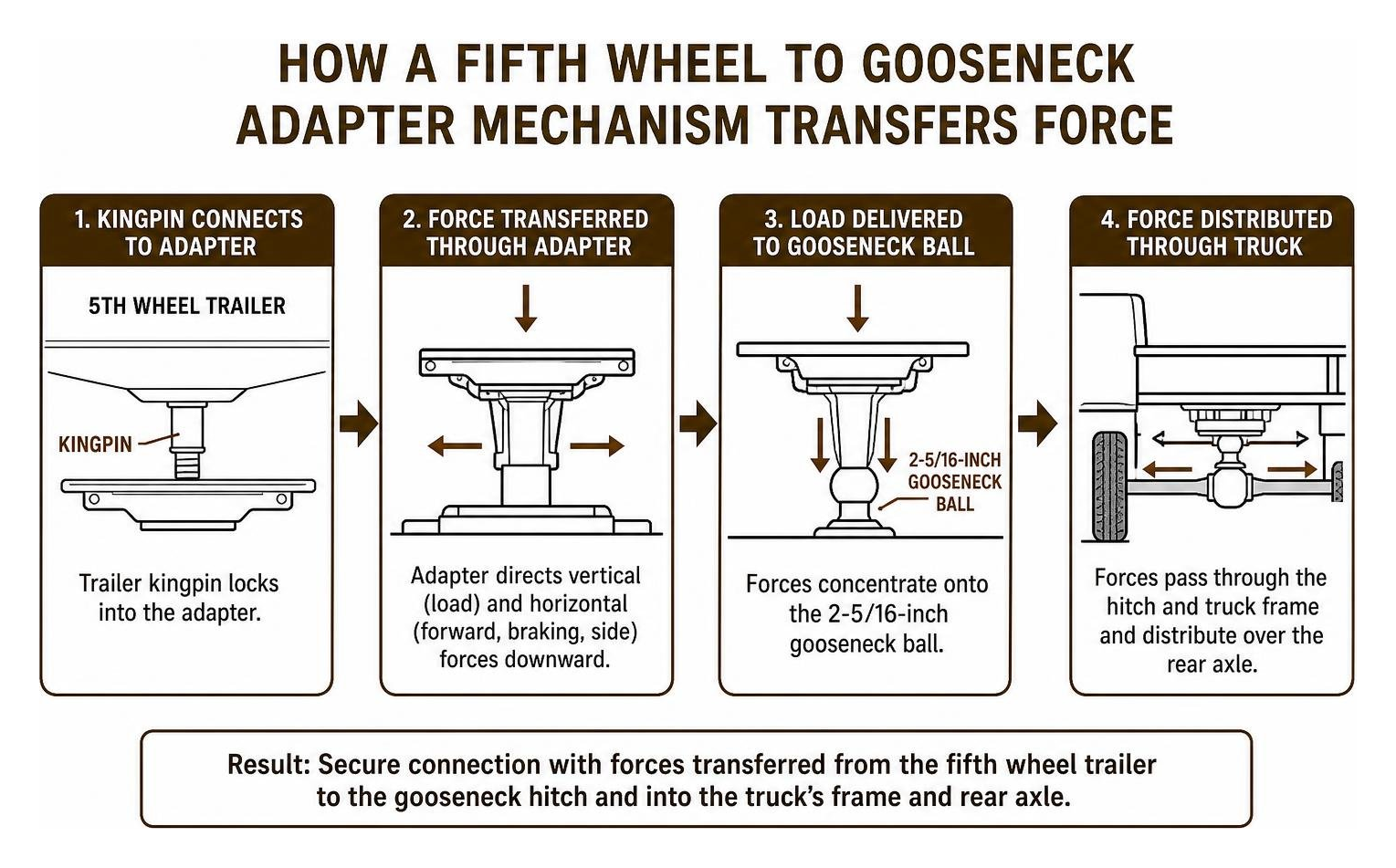
A 5th-wheel adapter for a transfer trailer resolves this split by converting one towing style into the other without requiring you to permanently alter your truck’s chassis. Exploring modern towing setups reveals that installing an adapter allows a truck equipped with an under-bed gooseneck ball to haul a standard kingpin-equipped trailer, or lets a fifth-wheel hitch plate couple directly to a gooseneck pipe. This flexibility frees up truck bed utility, saves on costly dual-hitch setups, and ensures your heavy transfer loads move securely between job sites and campgrounds.
Gooseneck Ball vs 5th Wheel Kingpin Coupling
The fundamental difference between these two coupling styles lies in pivot mechanics and force distribution:
- Gooseneck Hitch Coupling: Relies on a spherical ball (standard 2-5/16 inch) mounted flush inside the truck bed. The coupler drops vertically over the ball, allowing multi-axis articulation. This system is heavily favored in agricultural, commercial transfer, and industrial hauling because removing the ball leaves an entirely flat, usable truck bed.
- 5th Wheel Kingpin Hitch: Employs a downward-facing steel kingpin (typically 2 inches) welded into a trailer pin box. The kingpin slides horizontally into the jaws of a large, raised fifth-wheel hitch plate mounted on bed rails. This wide plate provides exceptional lateral stability, which helps manage sway on tall recreational vehicles.
Converting between the two requires careful attention to chucking (the forward-and-back jerking motion during braking and acceleration). Quality adapters integrate tight-tolerance locking jaws or internal dampeners to prevent play at the connection point.
Adapter Plates vs Direct Pin Box Replacements
When outfitting your rig, you will encounter two primary engineering approaches: drop-in adapter plates and direct pin box replacements.
- Drop-In Adapter Plates / Base Adapters: These units lock straight into an existing under-bed gooseneck hitch hole or factory puck system, providing standard rails above the bed floor. Alternatively, top-mount adapter plates slide into fifth-wheel jaws to present an upright gooseneck ball. These allow rapid swapping between equipment types, though they can introduce a minor reduction in net payload capacity.
- Replacement Pin Boxes & Sleeve Adapters: These units bolt directly onto the trailer’s structural pin box wings (or clamp over the existing kingpin). They extend downward into an integrated gooseneck coupler tube, completely eliminating the need for a bulky fifth-wheel hitch sitting in your truck bed.
| Adapter Style | Gross Trailer Weight (GTWR) | Tongue Weight Rating | Truck Bed Impact | Best Application |
|---|---|---|---|---|
| Drop-In Adapter Plate | 20,000 – 25,000 lbs | 5,000 – 6,250 lbs | Adds elevated base rails across bed | Dual-purpose trucks hauling multiple commercial rigs |
| Direct Pin Box Replacement | 24,000 – 30,000 lbs | 6,000 – 7,500 lbs | Leaves bed completely flat when uncoupled | Long-term conversion for RVs and dedicated transfer rigs |
| Sleeve Kingpin Clamp-On | 20,000 – 24,000 lbs | 5,000 – 6,000 lbs | Leaves bed completely flat when uncoupled | Straightforward bolt-on conversions without full box removal |
| Inverted 5th-to-Gooseneck Plate | 20,000 – 30,000 lbs | 5,000 – 7,500 lbs | Requires 5th-wheel hitch head in bed | Towing commercial gooseneck trailers with 5th-wheel pickups |
Top Adapter Solutions for Heavy-Duty Transfer and RV Rigs
Finding the right adapter means balancing your trailer’s maximum loaded weight with how quickly you want to clear your truck bed for everyday hauling. Below are top-tier commercial and recreational adapters built to handle high-stress hauling.
Andersen Ranch Hitch: High-Clearance Remote Latch
The Ranch Hitch Adapter from Andersen is one of the most widely used sleeve-style conversion adapters on the market. Engineered to meet strict V19 safety standards, this adapter connects directly to your trailer’s standard fifth-wheel kingpin and extends downward to latch securely onto any 2-5/16-inch gooseneck ball.
- Gross Trailer Weight Rating: 24,000 lbs
- Tongue Weight Capacity: 6,000 lbs
- Vertical Adjustability: 3-inch adjustment range (from 11-3/4 inches to 14-3/4 inches)
- Key Features: Integrated 5-7/8-inch funnel coupler for effortless hitch alignment and a remote cable release that allows you to unlatch the ball without climbing into the bed.
Choosing a 5th Wheel Adapter for Transfer Trailer Pin Box Models
If your transfer setup or heavy fifth wheel utilizes common commercial wing boxes, replacing the entire pin box structure often yields superior vibration isolation. The Shocker 5th Wheel to Gooseneck Demco Coupler Conversion Kit is an exceptional direct-replacement assembly engineered to fit Lippert 1621, Lippert 0719, and Rhino Box bolt patterns.
This setup supports up to 24,000 lbs gross trailer weight and 6,000 lbs tongue weight. Its built-in Demco EZ-latch coupler automatically locks onto the gooseneck ball upon contact, providing an ultra-secure connection while drastically reducing road chucking and frame fatigue.
CURT X5 and Puck System Conversion Plates
For drivers who already have an under-bed gooseneck system or an OEM prep package from Chevy, Ford, or GMC, adapter plates offer quick, tool-free flexibility:
- CURT X5 Gooseneck-to-5th-Wheel Adapter Plate: Designed specifically for round gooseneck hitch shafts (such as the CURT Double Lock EZr), this 106-lb steel plate drops straight into the gooseneck ball hole. It locks in place without tools to provide industry-standard above-bed fifth-wheel rails rated at 20,000 lbs GTW.
- CURT 20K A20 5th Wheel Hitch with Slider: If your truck features factory pucks, this heavy-duty unit combines a cast-iron articulating torsion head with quarter-turn anchoring legs. It delivers up to 20,000 lbs capacity and integrates poly-torsion inserts to dampen shock loads during commercial transport.
Commercial-Grade Couplers and Yard Movers
When dealing with heavy-duty commercial rigs up to 30,000 lbs GTWR, standard recreational hardware will not suffice:
- Wallace Forge Gooseneck-to-5th-Wheel Converters: Built in the USA from cast alloy steel, Wallace Forge inverted adapters lock directly into heavy fifth-wheel jaws to provide an upright 2-5/16-inch gooseneck ball. Rated at a massive 30,000 lbs capacity, they are ideal for commercial transfer yards switching between long-haul flatbeds and gooseneck dumps.
- Yard Maneuvering Attachments: Moving heavy fifth-wheel rigs around tight shop spaces or commercial lots without hitching up a full-size pickup is made simple using dedicated movers. The Hands-free Forklift Trailer Hitch Attachment slides straight onto standard forklift forks to position empty trailers quickly and safely. For motorized standalone movement, the Transformer Trailer Dolly provides remote-controlled parking power for rigs weighing up to 15,000 lbs.
Critical Fitment Factors: Kingpins, Bed Lengths, and Weight Ratings
Selecting the correct adapter requires auditing your truck’s physical bed geometry and checking the structural limits of the trailer chassis. Browsing our comprehensive towing category will help you better understand overall load dynamics before you buy.
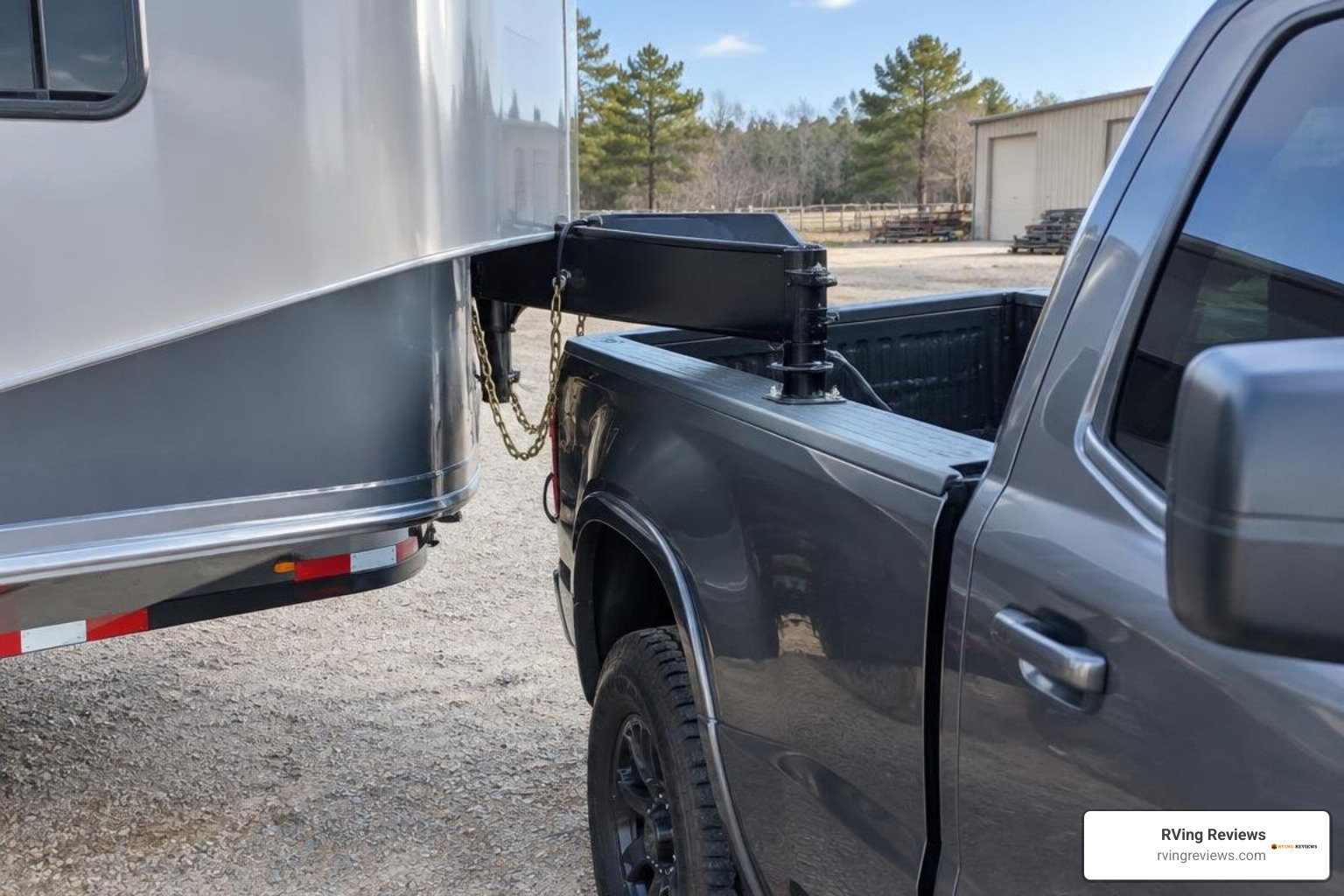
Straight vs 8-Inch Offset Adapters for Short Beds
Short-bed pickup trucks (typically 6-foot to 6.5-foot beds) present turning clearance challenges when hooked to wide fifth-wheel trailer caps. During tight 90-degree maneuvers or backing into tight transfer bays, the corner of the trailer can swing dangerously close to the truck’s rear cab glass.
- Straight Adapters: Position the pivot point directly over the center of the gooseneck ball. These are ideal for long-bed (8-foot) pickups where cab clearance is not an issue.
- 8-Inch Offset Adapters: Shift the connection point 8 inches toward the rear tailgate. This rearward shift creates the extra turning radius needed for short-bed trucks, preventing cab strikes without requiring an expensive, cumbersome sliding hitch assembly.
Weight Ratings, Tongue Capacity, and Frame Stress
You must calculate both the Gross Trailer Weight Rating (GTWR) and vertical pin weight (tongue load) before settling on an adapter model:
- Weight Rating Ceiling: While standard gooseneck setups handle up to 30,000 lbs, many bolt-on adapters are rated between 20,000 and 24,000 lbs GTWR with a 5,000 to 6,000 lb tongue limit. Always match your setup to the lowest-rated component in your towing chain.
- Leverage and Structural Stress: Sleeve-style vertical adapters that clamp onto a kingpin and extend down 12 to 17 inches create a long mechanical lever arm. This added leverage increases torsional force against the trailer’s front overhang and frame gussets during hard braking. Always check with your trailer frame manufacturer (such as Lippert Components) to confirm that your specific pin box and upper frame welds are approved for gooseneck adapter extensions.
Installing a 5th Wheel Adapter Safely
Proper installation ensures stable tracking, eliminates slop, and prevents structural damage to both truck and trailer.
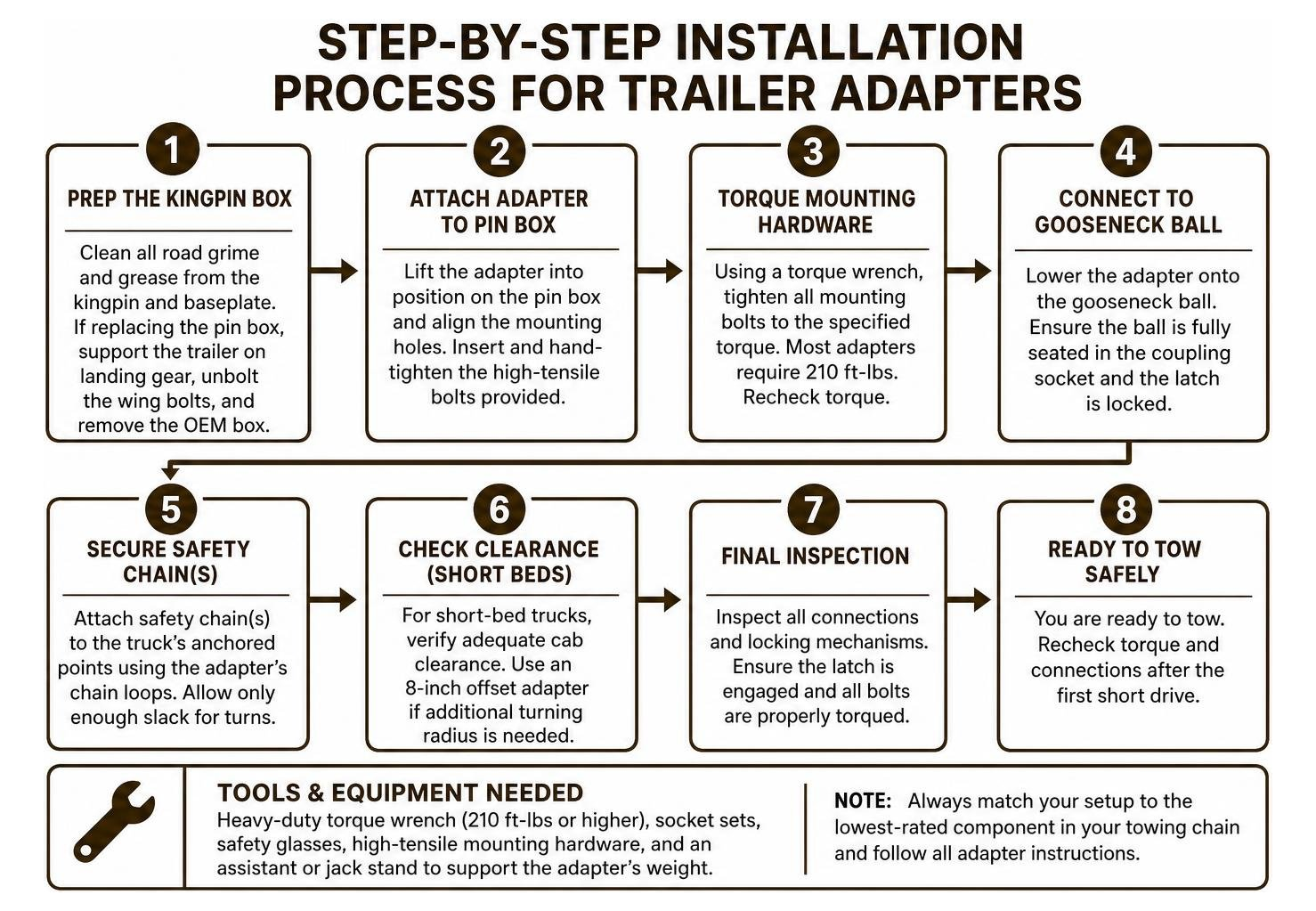
Step-by-Step Bolt-On and Drop-In Installation
Before starting, gather the necessary tools: a heavy-duty torque wrench capable of reaching at least 210 ft-lbs, socket sets, safety glasses, high-tensile mounting hardware, and an assistant or jack stand to support the adapter’s weight.
- Prep the Kingpin Box: Clean all road grime and grease from the kingpin and baseplate. If installing a full pin box replacement (such as a Shocker Hitch kit), safely support the trailer front on landing gear, unbolt the factory wing bolts, and remove the OEM box.
- Mount the Adapter Collar: For sleeve adapters, slide the adapter collar up over the kingpin until the top plate sits completely flush against the trailer skid plate.
- Torque Fasteners to Spec: Secure the locking wedge bolts and kingpin set screws. Using your torque wrench, tighten all bolts in an alternating cross pattern to the manufacturer’s exact specifications (typically between 160 and 210 ft-lbs).
- Adjust Coupler Height: Set the lower coupler sleeve to provide at least 6 inches of clearance between the top of your truck bed rails and the underside of the trailer frame when parked on level ground. Tighten all height-locking through-bolts.
- Engage and Test: Back the truck under the trailer until the gooseneck ball seats firmly into the adapter coupler. Lock the collar, attach the safety release cable, and execute a gentle trailer brake pull-test before hitting the road.
Safety Chains, Breakaway Cables, and Legal Compliance
Unlike fifth-wheel hitches—where the positive locking jaws around a kingpin exempt the setup from safety chain requirements in many jurisdictions—any ball-and-coupler connection is legally classified as a gooseneck hitch.
When using a fifth-wheel-to-gooseneck adapter, you must install and cross DOT-rated safety chains between the trailer adapter and the under-bed tie-down anchors. Ensure the chains have enough slack to allow full-radius turns without binding, but remain short enough to prevent the tongue from contacting the pavement if an accidental uncoupling occurs. Always connect the emergency electronic breakaway brake lanyard to a secure mounting point on the truck body.
Frequently Asked Questions About 5th Wheel Adapters
Are safety chains legally required when using a 5th wheel to gooseneck adapter?
Yes. Department of Transportation (DOT) regulations and state traffic laws classify any connection that rests over a 2-5/16-inch hitch ball as a gooseneck coupler. Because it relies on a ball rather than an interlocking mechanical fifth-wheel jaw, high-strength safety chains rated to match or exceed your trailer’s gross weight are legally mandated across North America.
Can using a gooseneck adapter void my trailer’s frame warranty?
In some cases, yes. Standard sleeve adapters increase the physical distance between the frame welds and the pivot point, multiplying torque forces on the front structure. While modern replacement pin boxes (such as the Reese Goose Box or Shocker Demco kits) are fully approved by major chassis builders like Lippert, adding a basic rigid extension tube to an unapproved pin box can void upper-deck frame warranties. Always review your manufacturer’s technical bulletins before installation.
What is the price range for a reliable heavy-duty 5th wheel adapter?
Quality adapters typically range from $200 to $1,800:
- Entry-level inverted plates and kingpin sleeves: $200 – $450 (e.g., Wallace Forge, RAM, basic bolt-on sleeves).
- Mid-tier adjustable adapters: $450 – $900 (e.g., Andersen Ranch Hitch, CURT X5 conversion plates).
- Premium cushioned direct-replacement pin boxes: $1,200 – $1,800 (e.g., Shocker Hitch Demco kits, specialized air-ride systems).
Choosing the Best Hitch Setup for Your Rig
Matching the right adapter to your transfer trailer setup comes down to understanding your payload, respecting frame leverage dynamics, and choosing hardware that preserves your truck bed’s versatility. Whether you opt for an offset sleeve adapter for short-bed cab clearance or an integrated replacement pin box to eliminate highway chucking, always prioritize equipment that meets V19 structural standards and aligns with your chassis ratings.
For detailed breakdowns, field tests, and comprehensive towing hardware reviews, explore our in-depth 5th wheel to gooseneck adapter guide to upgrade your rig with complete confidence. Safe travels and happy hauling!