
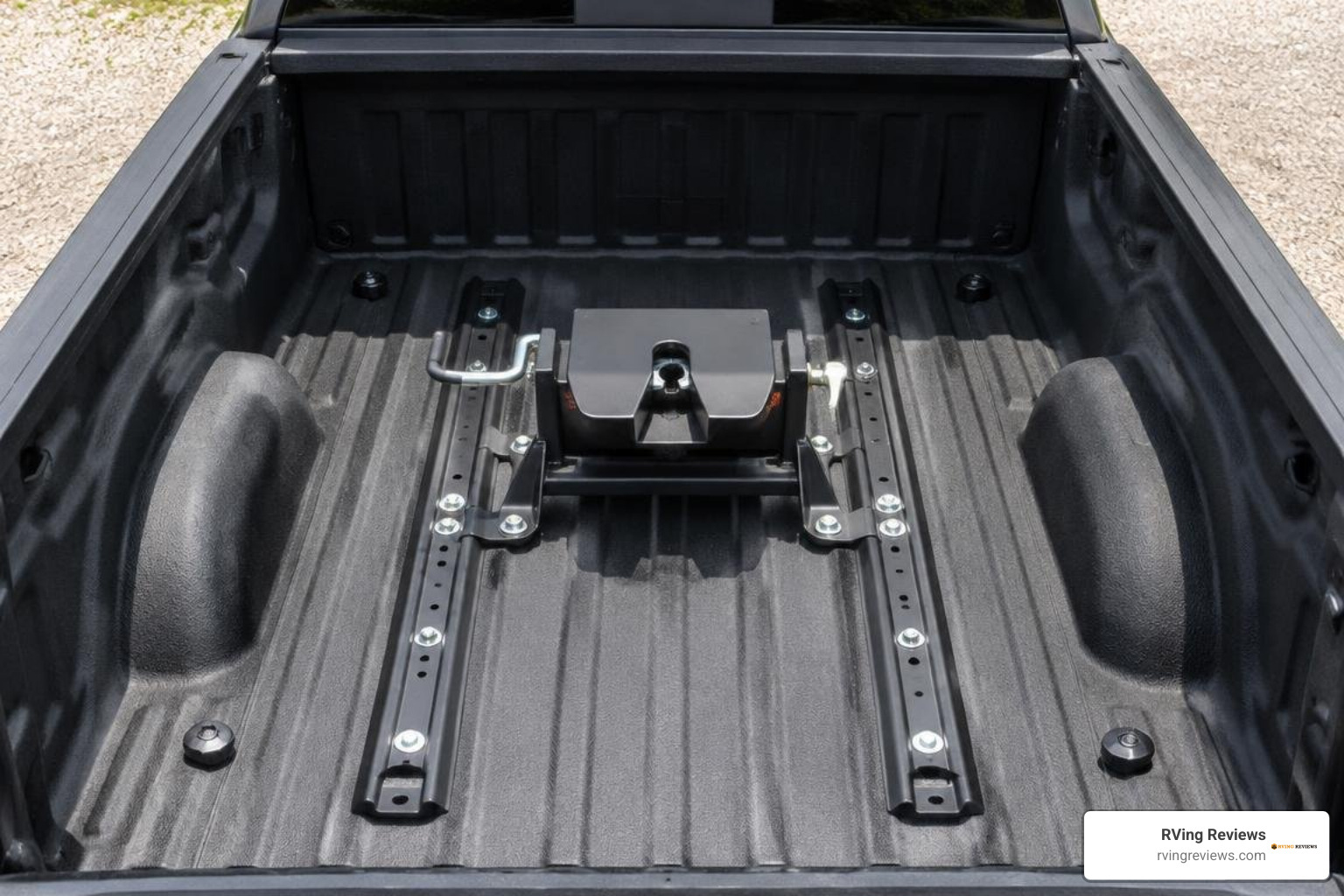
What a 5th Wheel Rail Adapter Does
A 5th wheel rail adapter lets you use a hitch built for standard above-bed rails in a truck with a different mounting system, such as factory pucks. The adapter locks into the truck’s mounting points and gives the hitch a set of rails to attach to. It can save you from replacing a hitch you already own.
Check fit before you buy: Match the adapter to your truck’s year and factory mounting system, then confirm that your hitch fits its rails. Check both the trailer-weight and vertical-load ratings, and measure the added hitch height. An adapter that fits the pucks can still leave you with too little trailer-to-bed clearance.
I’m 📈Benjamin Beck, Growth Marketing Expert. I’ve spent more than 14 years turning product research into clear buying guidance; this guide applies that approach to choosing a 5th wheel rail adapter.
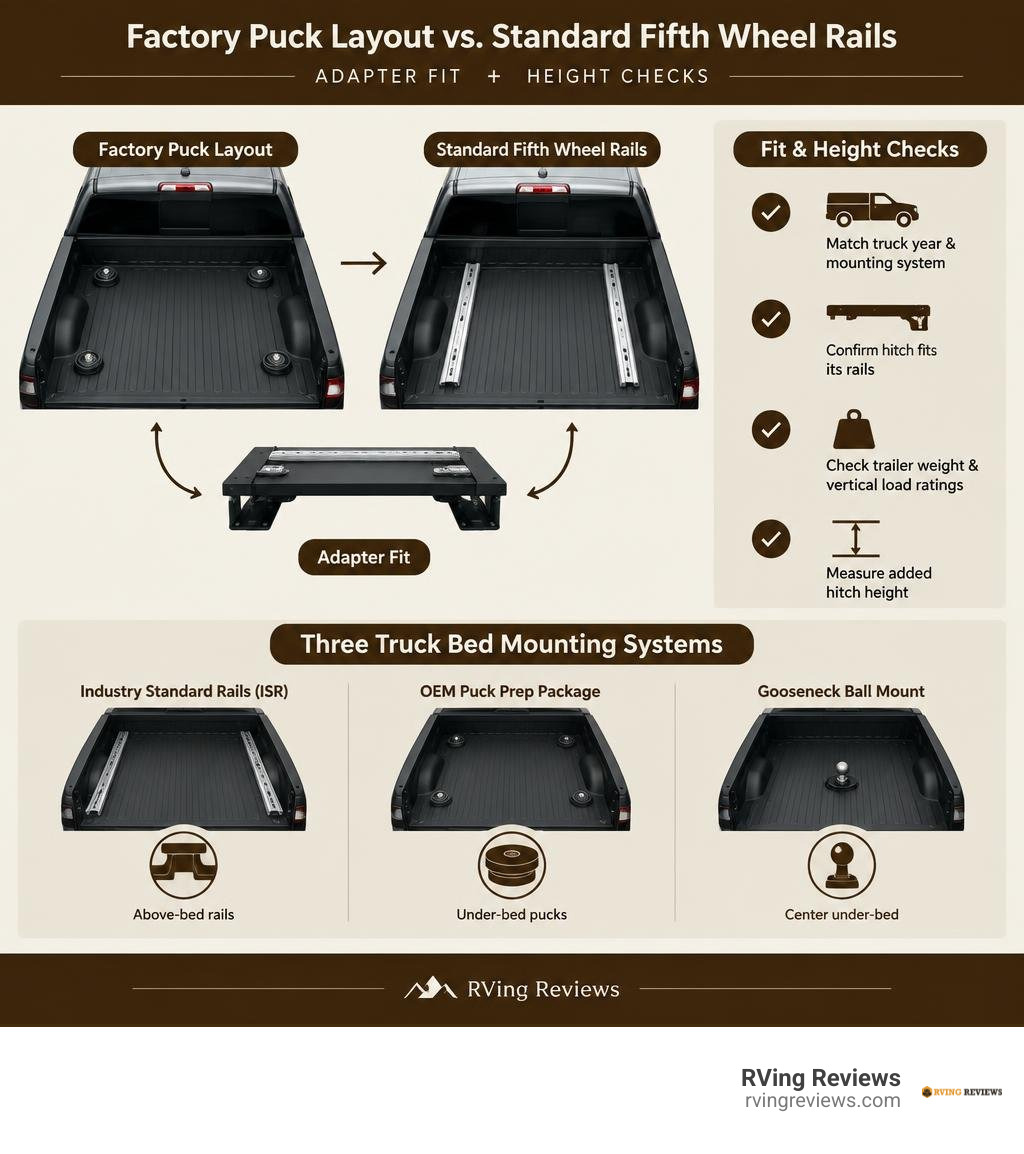
Types and Configurations of a 5th Wheel Rail Adapter
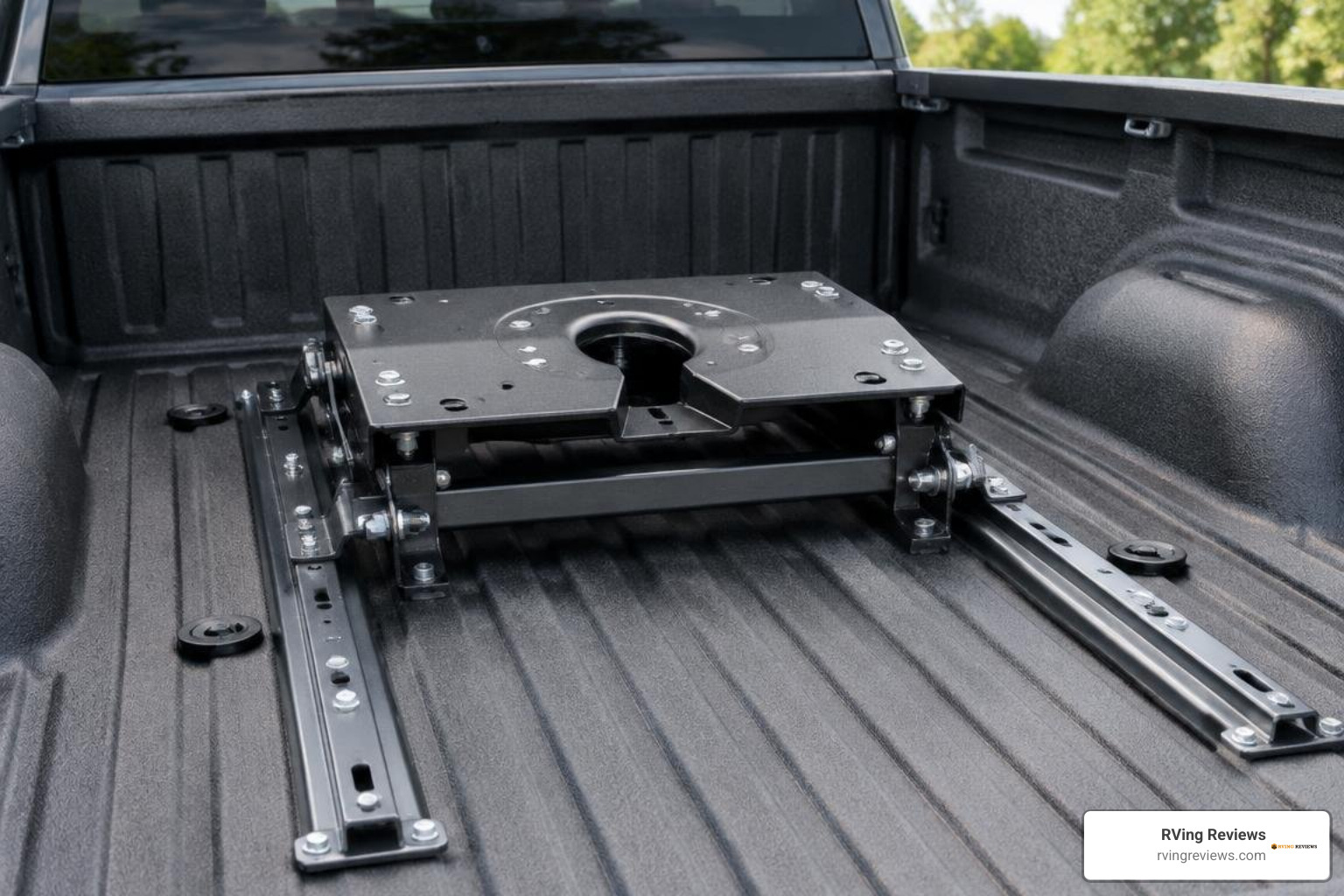
When upgrading trucks or repurposing a favorite hitch, you quickly discover that mounting systems are not universal. Truck beds generally feature one of three setups: traditional above-bed Industry Standard Rails (ISR), an under-bed Original Equipment Manufacturer (OEM) puck prep package, or a center under-bed gooseneck ball mount.
A 5th wheel rail adapter serves as the structural bridge between these differing standards. Instead of bolting permanent rails through your new truck bed or throwing out a perfectly functional $1,000 hitch, you insert a specialized adapter plate that matches your truck’s mounting footprint. These adapters fall into distinct categories designed for specific truck configurations and towing goals.
Puck-to-Rail 5th Wheel Rail Adapter Options
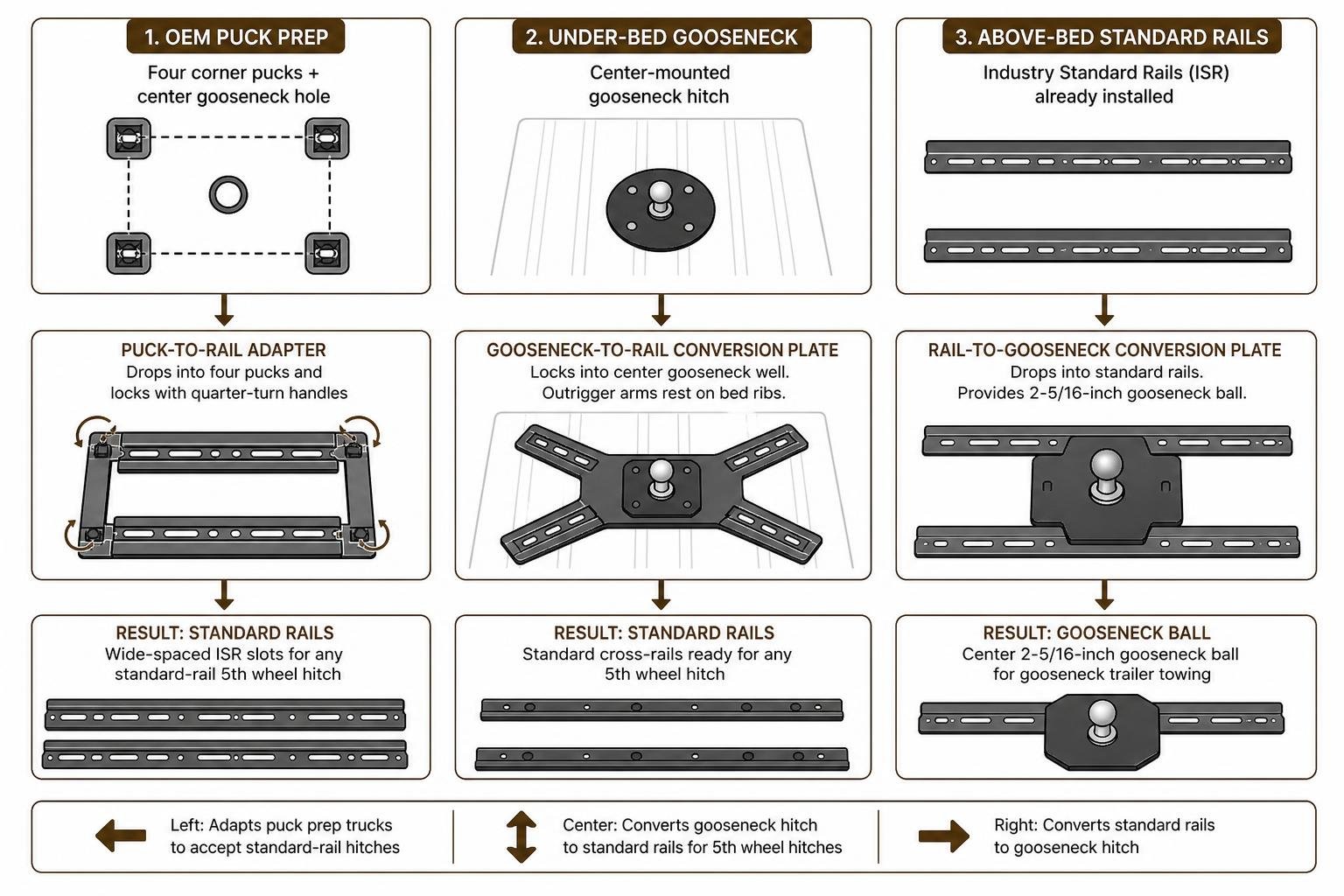
The most common configuration is the puck-to-rail adapter. Modern heavy-duty trucks from Ford, GM (Chevrolet/GMC), and RAM frequently roll off the assembly line with factory-installed 5th wheel prep packages. These systems feature four corner anchor points (pucks) and a center gooseneck hole integrated beneath the bed floor.
Puck-to-rail adapters drop directly into these four receiver points. They secure via quarter-turn locking handles, presenting a standard set of wide-spaced ISR slots on top. This allows you to drop in any standard-rail hitch—including manual sliders, automatic sliders, and fixed-leg units—and secure it using standard pins and clips.
Because Ford, GM, and RAM use different center-to-center spacing and hole diameters for their puck designs, you must select an adapter engineered specifically for your truck’s make and platform generation. Review the manufacturer’s specifications to confirm the adapter’s dimensions and whether it preserves slider functionality.
| Adapter Model / Brand | Primary Truck Compatibility | Gross Trailer Weight (GTW) | Vertical Pin Load Limit | Approximate Height Rise |
|---|---|---|---|---|
| Make-Specific Adapter | Ford, Chevy, GMC (Select Years) | 25,000 lbs | 6,250 lbs | 2.5 inches |
| Reese 30156 | Ford Super Duty (OEM / Elite) | 20,000 lbs | 5,000 lbs | 2.5 inches |
| Demco 6175 | Ford / GM / RAM (Make-Specific) | 25,000 lbs | 6,250 lbs | 2.0 inches |
| PullRite 4442 | RAM HD (Factory Puck Prep) | 20,000 lbs | 5,000 lbs | 2.5 inches |
| Ford OEM Kit | Ford Super Duty (2011–2026) | 20,000 lbs | 5,000 lbs | 2.5 inches |
Gooseneck-to-Rail and Conversion Plates
If your truck bed has a center-mounted under-bed gooseneck hitch rather than a four-corner puck array, gooseneck-to-rail conversion plates solve the compatibility problem.
These plates feature a heavy-duty steel shank (or integrated 2-5/16-inch ball coupler) that locks into the truck’s central gooseneck well. Outrigger arms extend from the center post to rest securely against the truck bed ribs, establishing standard cross-rails for your fifth-wheel hitch. Manufacturer installation materials can help confirm whether a specific plate provides rail conversion without permanent modifications or tools.
Conversely, if you own a truck with permanent above-bed standard rails but occasionally need to pull a gooseneck livestock trailer or flatbed, rail-to-gooseneck conversion plates work in reverse. Heavy-duty plates, such as the Reese Pro Series 49080, drop right into standard rail slots and provide a 2-5/16-inch ball rated up to 25,000 lbs GTW. Many of these plates include a reversible 2-inch offset, allowing you to position the ball slightly forward or rearward to optimize cab and tailgate clearances.
If you are exploring other ways to switch between hitch styles, you can also consider a dedicated 5th wheel to gooseneck adapter that mounts directly to the trailer’s pin box instead of adapting the truck bed floor.
Key Performance Factors: Weight Ratings, Clearances, and Safety
Adding an intermediate steel plate between your truck frame and your hitch changes your rig’s mechanical dynamics. Before hitching up for a cross-country journey, you need to understand weight capacities, physical clearances, and safety standards.
Weight Capacities and SAE J2638 Standards
Every component in your towing chain carries a maximum capacity rating. The most important rule of safe trailering is that your entire setup is only as strong as its lowest-rated component.
If your truck is rated to tow 30,000 lbs and your fifth-wheel hitch is rated for 24,000 lbs, but your adapter plate is rated for 20,000 lbs Gross Trailer Weight (GTW) and 5,000 lbs vertical pin load, your maximum legal and safe towing capacity is strictly 20,000 lbs. Exceeding this threshold places dangerous stress on the adapter’s locking pins and welded joints.
To ensure structural reliability, reputable adapter manufacturers test their products against SAE J2638 protocols. This rigorous automotive engineering standard subjects fifth-wheel and gooseneck components to millions of cycles of static, vertical, longitudinal, and transverse fatigue testing. Always verify that an adapter carries an SAE J2638 compliance certification before purchasing, ensuring proper margins for your overall towing safety.
Hitch Height, Bed Clearance, and Ride Quality
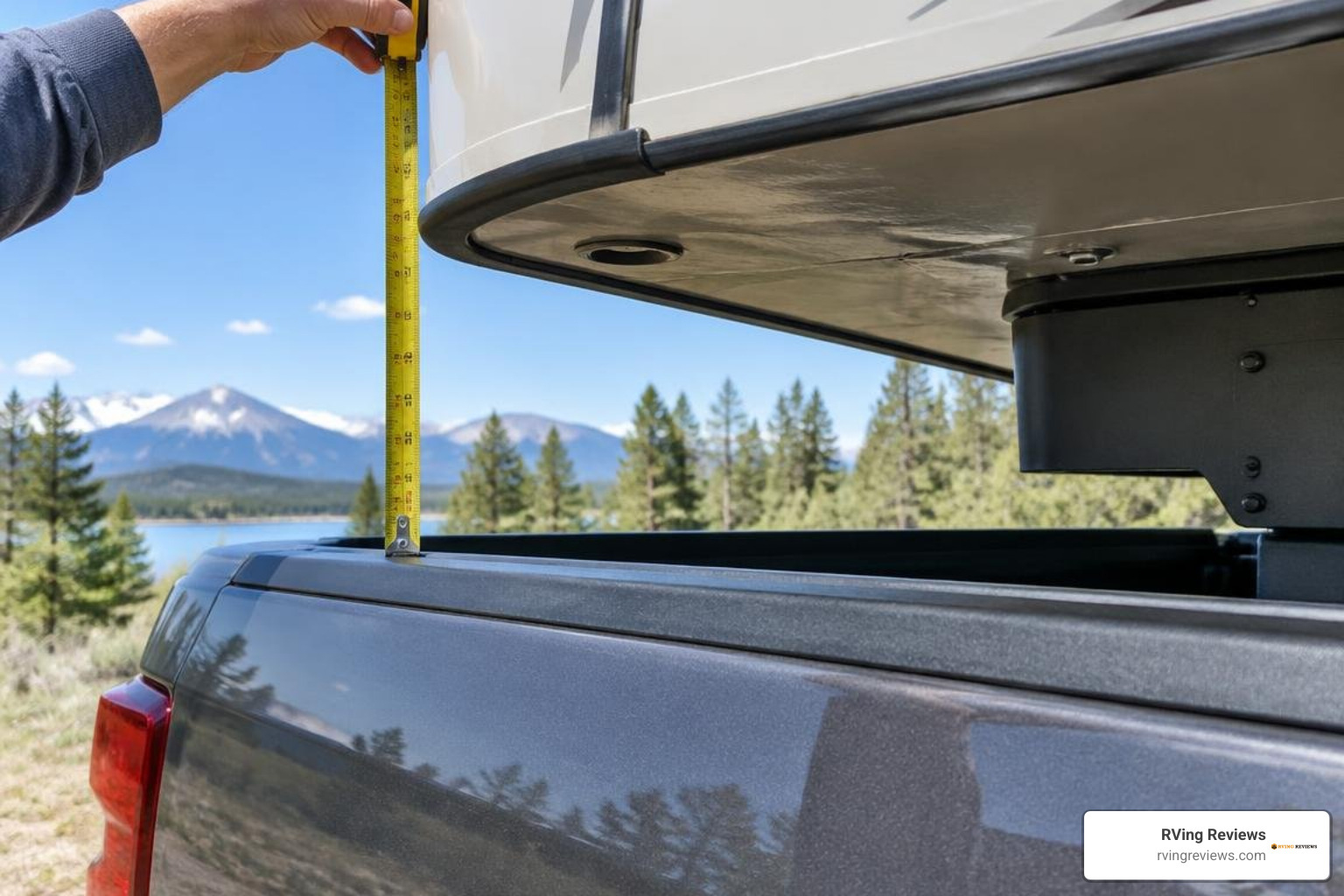
One critical factor that RV owners frequently overlook is the vertical height profile. An adapter plate adds between 2.0 and 2.5 inches of extra height to the base of your hitch.
This added height impacts your rig in two major ways:
- Trailer Levelness: Raising the front of your fifth wheel by more than two inches can cause the trailer to ride nose-high. This shifts disproportionate weight onto the rear trailer axle, leading to premature tire wear, elevated bearing temperatures, and poor braking stability.
- Bed Rail Clearance: To safely navigate gas station transitions, steep driveways, and unpaved campsites, you must maintain a minimum of 5.5 to 6 inches of clearance between the top of your truck bed rails and the underside of the trailer overhang.
If your hitch legs have multiple bolt-hole settings, you can often lower the hitch head assembly by one or two notches to counteract the adapter’s 2-inch rise. Always take precise measurements on level ground before your maiden voyage.
Additionally, introducing an extra mechanical connection into your bed can introduce “chucking” (fore-and-aft jerking during acceleration and braking) or rattling noises. High-quality adapters resolve this using adjustable castle-nut anchors or built-in isolator pads. Watch out for thick spray-in or drop-in bedliners, as excess liner thickness under the puck collars can prevent the adapter feet from seating completely flat, resulting in unwanted movement.
Step-by-Step Setup: How to Install a 5th Wheel Rail Adapter Safely
Installing a puck-to-rail adapter is straightforward and typically takes less than 15 minutes once adjusted. Because most adapters weigh between 40 and 85 lbs, having a second pair of hands nearby makes positioning the unit over the bed easier.
Tool Requirements and Pre-Trip Security
Before beginning, gather the basic tools needed for setup and calibration:
- A flat-blade screwdriver or small needle-nose pliers (to remove cotter pins)
- Sockets and open-ended wrenches (typically 1-1/2-inch or 15/16-inch, depending on anchor hardware)
- A tape measure
- A clean shop rag and dry silicone or lithium lubricant
While setting up your hitch, you should also protect your valuable towing hardware against opportunistic theft by outfitting your receiver and hitch pins with the best trailer hitch lock.
Anchor Adjustment and Locking Mechanism
Follow these practical steps to achieve a tight, chatter-free fit:
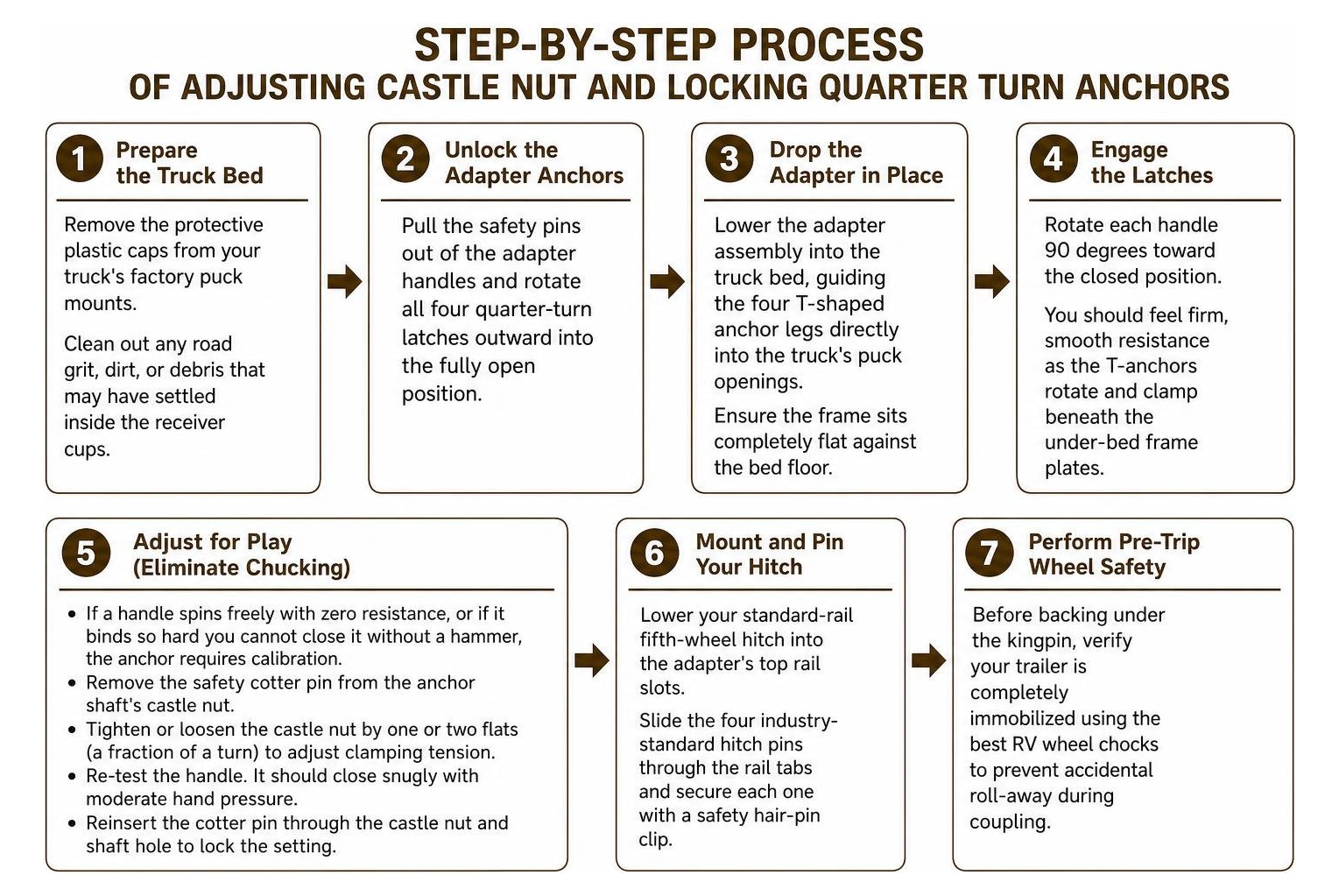
- Prepare the Truck Bed: Remove the protective plastic caps from your truck’s factory puck mounts. Clean out any road grit, dirt, or debris that may have settled inside the receiver cups.
- Unlock the Adapter Anchors: Pull the safety pins out of the adapter handles and rotate all four quarter-turn latches outward into the fully open position.
- Drop the Adapter in Place: Lower the adapter assembly into the truck bed, guiding the four T-shaped anchor legs directly into the truck’s puck openings. Ensure the frame sits completely flat against the bed floor.
- Engage the Latches: Rotate each handle 90 degrees toward the closed position. You should feel firm, smooth resistance as the T-anchors rotate and clamp beneath the under-bed frame plates.
- Adjust for Play (Eliminate Chucking):
- If a handle spins freely with zero resistance, or if it binds so hard you cannot close it without a hammer, the anchor requires calibration.
- Remove the safety cotter pin from the anchor shaft’s castle nut.
- Tighten or loosen the castle nut by one or two flats (a fraction of a turn) to adjust clamping tension.
- Re-test the handle. It should close snugly with moderate hand pressure. Reinsert the cotter pin through the castle nut and shaft hole to lock the setting.
- Mount and Pin Your Hitch: Lower your standard-rail fifth-wheel hitch into the adapter’s top rail slots. Slide the four industry-standard hitch pins through the rail tabs and secure each one with a safety hair-pin clip.
- Perform Pre-Trip Wheel Safety: Before backing under the kingpin, verify your trailer is completely immobilized using the best RV wheel chocks to prevent accidental roll-away during coupling.
Adapter vs. Dedicated Puck Hitch: Long-Term Value and Alternatives
When budgeting for a new truck and hitch setup, deciding between buying an adapter plate or investing in a brand-new, direct-mount puck hitch comes down to cost, lifting weight, and long-term convenience.
Cost Comparison, Weight, and Truck Bed Space
| Feature / Factor | 5th Wheel Rail Adapter + Existing Hitch | Dedicated Direct-Mount Puck Hitch |
|---|---|---|
| Typical Cost | $400 – $600 | $1,100 – $1,800+ |
| Lifting Weight | Modular: Adapter (45–80 lbs) + Hitch (100–160 lbs) | Heavy Single Unit: 130–220 lbs (often breaks down into 2 pieces) |
| Height Added | Adds 2.0 to 2.5 inches to hitch height | Zero added height (engineered to optimal bed depth) |
| Mechanical Joints | Two connection points (Pucks to Adapter, Adapter to Hitch) | One direct connection point (Hitch to Pucks) |
| Bed Utility When Removed | 100% clean, flat truck bed | 100% clean, flat truck bed |
An adapter plate is the clear winner for cost efficiency. Spending roughly $450 for a certified adapter lets you keep using a hitch that might otherwise cost over $1,500 to replace.
The modular nature of an adapter setup also helps save your back. Removing a heavy hitch from a truck bed is much easier when you can unpin the hitch head, lift out the hitch body, and then remove the 50-lb adapter plate separately. When all components are removed, your truck bed remains completely flat, leaving ample open floor space for coolers, camping cargo, and your travel gear stored alongside the best RV bike racks.
Direct Puck Hitches and Air-Ride Pin Boxes
While adapters provide great utility, they do introduce a second set of mechanical connection points, which can slightly increase flex and potential chucking under heavy loads. If you regularly tow trailers exceeding 24,000 lbs, a dedicated direct-mount puck hitch provides unmatched rigidity and a lower profile.
Another popular alternative is replacing the traditional kingpin box on your trailer with an air-cushioned gooseneck conversion coupler (such as the Reese Goosebox). This system connects your fifth-wheel trailer directly to a single 2-5/16-inch gooseneck ball dropped into your truck’s center puck mount. It eliminates heavy hitches and adapter plates from your truck bed entirely, requiring only occasional lubrication at its grease zerks and air pressure checks before you hit the road.
Frequently Asked Questions About 5th Wheel Adapters
How much height does a rail adapter add to the hitch?
Most standard puck-to-rail adapters add between 2.0 and 2.5 inches of height above the truck bed floor. You can generally offset this rise by adjusting your fifth-wheel hitch head down by one or two mounting holes, keeping your trailer level while maintaining the required 5.5 to 6 inches of bed-rail clearance.
Can I use any standard rail 5th wheel hitch with a puck adapter?
Yes, as long as your hitch uses Industry Standard Rail (ISR) mounting tabs (measuring 22 inches front-to-back and approximately 10 inches side-to-side between pin holes) and its total weight does not exceed the adapter’s Gross Trailer Weight (GTW) and vertical pin load ratings.
How do I stop chucking and rattling noises from an adapter?
Rattling and chucking occur when the adapter’s anchor feet are adjusted too loosely within the puck receivers. To eliminate play, remove the safety cotter pin from each anchor shaft and tighten the castle nut by one or two flats until the locking handle closes with firm, solid hand pressure. Also, ensure that thick spray-in bedliner material is not preventing the adapter’s frame from seating flush against the bed floor.
Conclusion
A 5th wheel rail adapter is one of the most practical and cost-effective towing accessories available. It bridges the gap between older hitch equipment and modern truck bed engineering, saving you hundreds of dollars while keeping your truck bed clean and modular when you are not towing.
By matching the adapter directly to your truck make, properly calibrating your anchor castle nuts to stop chucking, and accounting for the 2-inch height rise, you can hit the highway with complete confidence. For those seeking alternative setups that bypass heavy bed hardware altogether, explore our comprehensive 5th wheel to gooseneck adapter guide for alternative heavy-duty towing options.